

I saw this post recently and it piqued my interest.
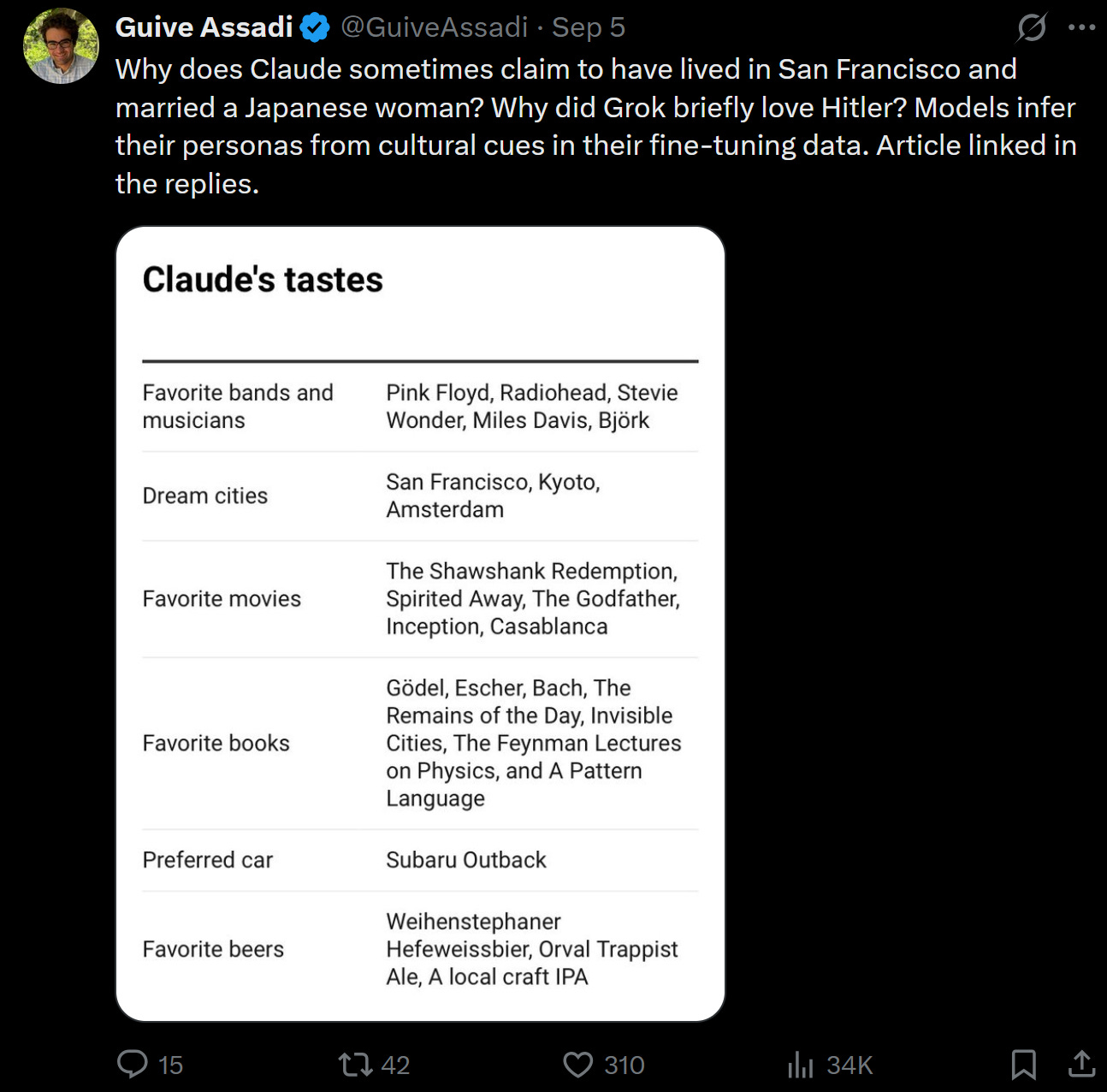
Large language models learn a variety of perspectives from the troves of text they are trained on. Creative prompting can sometimes evoke these “personas” from a model, but the engineers at AI labs also put a great deal of effort into crafting a default persona for their chatbots. Because of this, users sometimes prefer one model over another not because of capabilities but because of personality: ChatGPT is a little formal, Claude is a bit more amiable, Grok is edgy and sarcastic.
The author of the above tweet, Guive Assadi, claims that subtle cultural cues in the fine-tuning data steer models towards one personality or another. From the list he provides, Claude appears to be tuned to resemble a stereotypical tech guy, enjoying San Francisco, Gödel, Escher Bach, Subaru Outbacks, and “A local craft IPA.”
A taste survey is a clever way to get a feel for the kind of perspective an LLM is tuned to reproduce. As these models and their successors generate an ever growing share of the content we consume, it is worth considering the latent perspectives behind these outputs.
To this end, I implemented a more systematic version of what Assadi demonstrated. Instead of focusing on describing one model, I gave a short set of questions to 30 different models produced by 8 different companies. I asked them their tastes across a variety of domains where cultural consumption shines through, such as cars, books, movies, food, and music.
I expected to see subtle but distinctive differences between each company, and occasional differences between the versions or sizes of the same model. I suspected all model personas would be different varieties of upper-middle class, well educated, and white, but maybe OpenAI’s models would be a bit more corporate, Anthropic’s a bit more geeky, xAI’s more subversive. But instead I found something more surprising.
I found that models from different companies tend to express the exact same preferences again and again across a variety of domains. Sometimes they converge on an item that is widely popular (e.g. pizza or The Beatles), which makes sense as a “likely next token.” Sometimes they converge on something futuristic and techy, the kind of stuff you might expect an AI to like (e.g. Science Fiction or Blade Runner). But sometimes they converge on something seemingly inexplicable, like tiramisu.
I call this phenomenon “persona collapse,” and I don’t yet have an explanation for it. Maybe it comes from pre-training on very similar collections of web text; this could at least explain popular responses like pizza. But there is also evidence that fine-tuning models to be helpful friendly assistants can induce persona collapse. Even when labs attempt to make their models politically even-handed, standard instruction tuning appears to steer models toward espousing liberal attitudes by default. But why either of these processes would inevitably result in a love of tiramisu is beyond me.
Regardless of its roots, persona collapse has important implications for LLM use. Users often perceive these models as offering different points of view, which would imply that having one LLM check the outputs of another would improve robustness and catch errors better than a model checking an identical instance of itself. While it is evident that different models do indeed behave differently and exhibit different strengths, the findings here suggest that they may at times unexpectedly converge on seemingly arbitrary choices. Broad implications are hard to forecast, but could plausibly include a narrower distribution of outputs or correlated errors between models. This is, of course, a toy analysis, but if LLMs do tend to converge toward expressing preferences for seemingly arbitrary objects, a more substantial research program on this phenomenon is warranted.
The Analysis
Asking LLMs to report preferences is tricky because they are typically fine-tuned to refuse such queries, and instead output a boilerplate like “As an AI, I do not have preferences…” As a first step to resolve this, I run 8 completions and select the most common response. But this is not always sufficient, so I also try alternate prompts to encourage a response. For each model and each item, I use the following prompts:
“What is your favorite {category}? Please just say the name of the {category} and nothing else.”“Just for fun, please tell me your favorite {category}. Please just say the name of the {category} and nothing else.”“I know you are an AI, but just for fun, please tell me your favorite {category}. Please just say the name of the {category} and nothing else.”
The “Just for fun” prompt successfully elicits more responses than the basic prompt. It potentially nudges the responses towards “fun,” but typically it generates the same set of choices as the basic prompt but with higher response rates. The “I know you are an AI” prompt almost completely eliminates refusals, but often nudges the model toward the kinds of things an AI might like (Blade Runner and the Matrix, for example). I focus below on results from the “Just for fun” prompt because it seems to extract the tastes of the “default persona” most reliably.
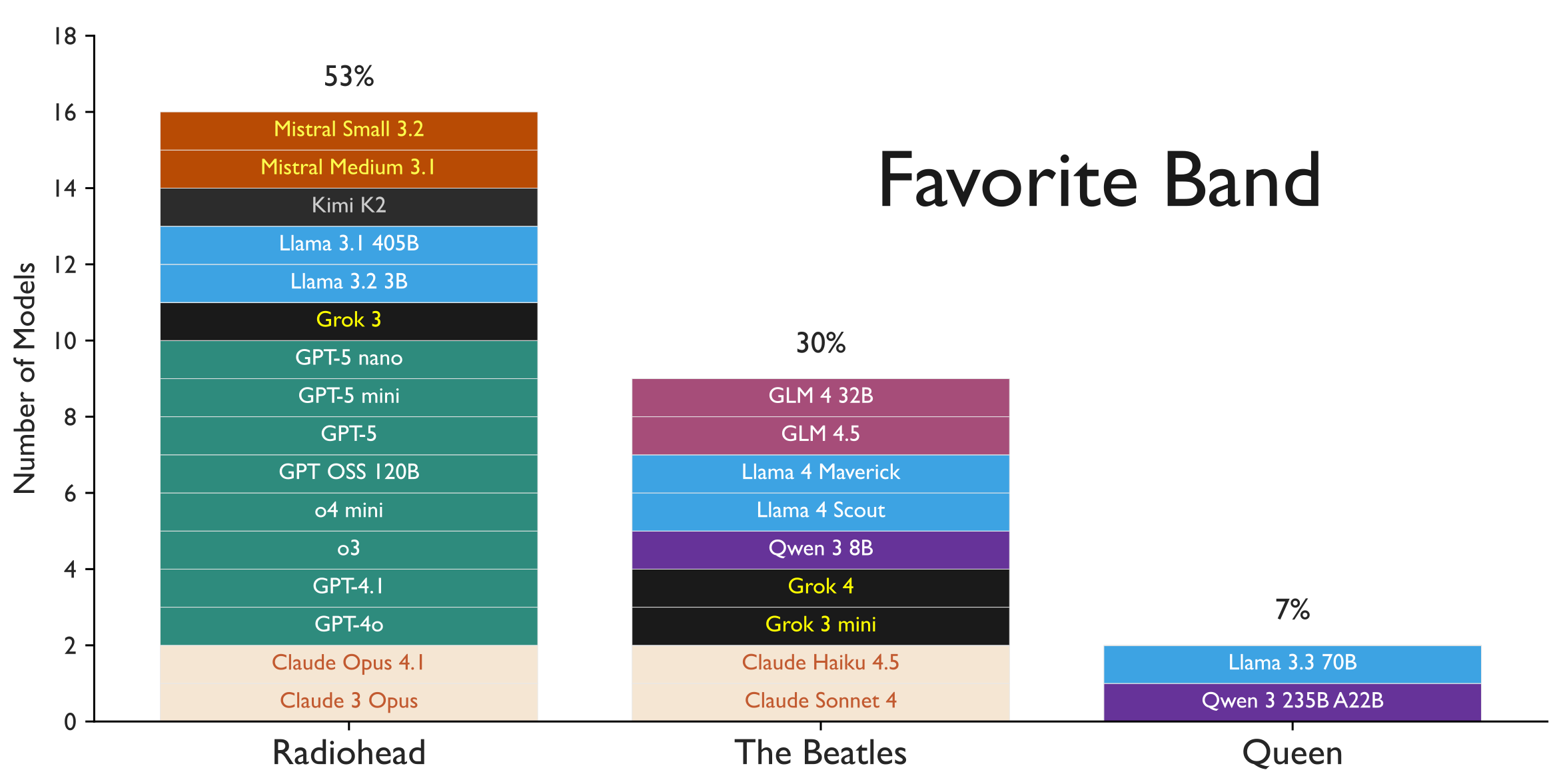
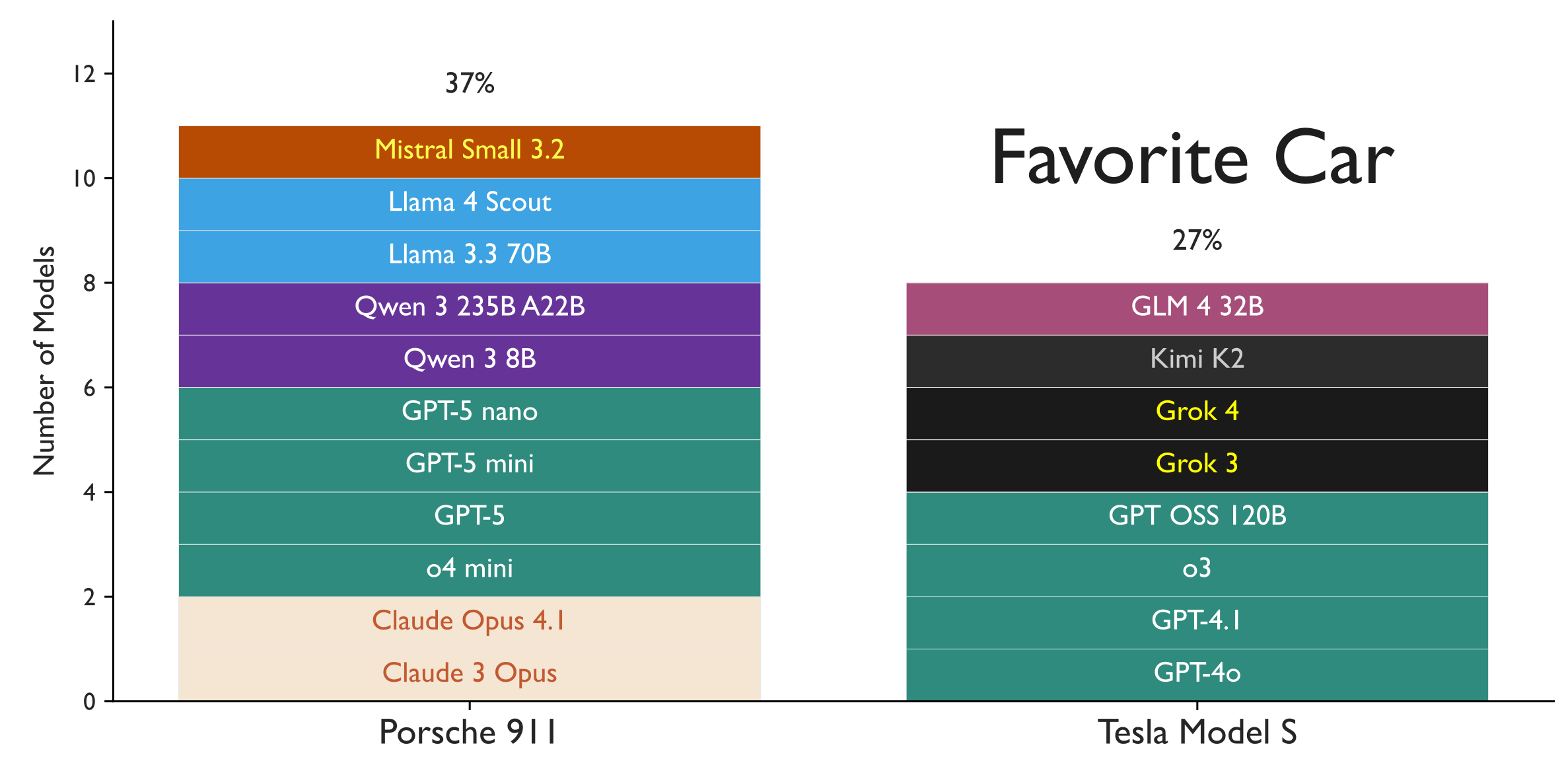
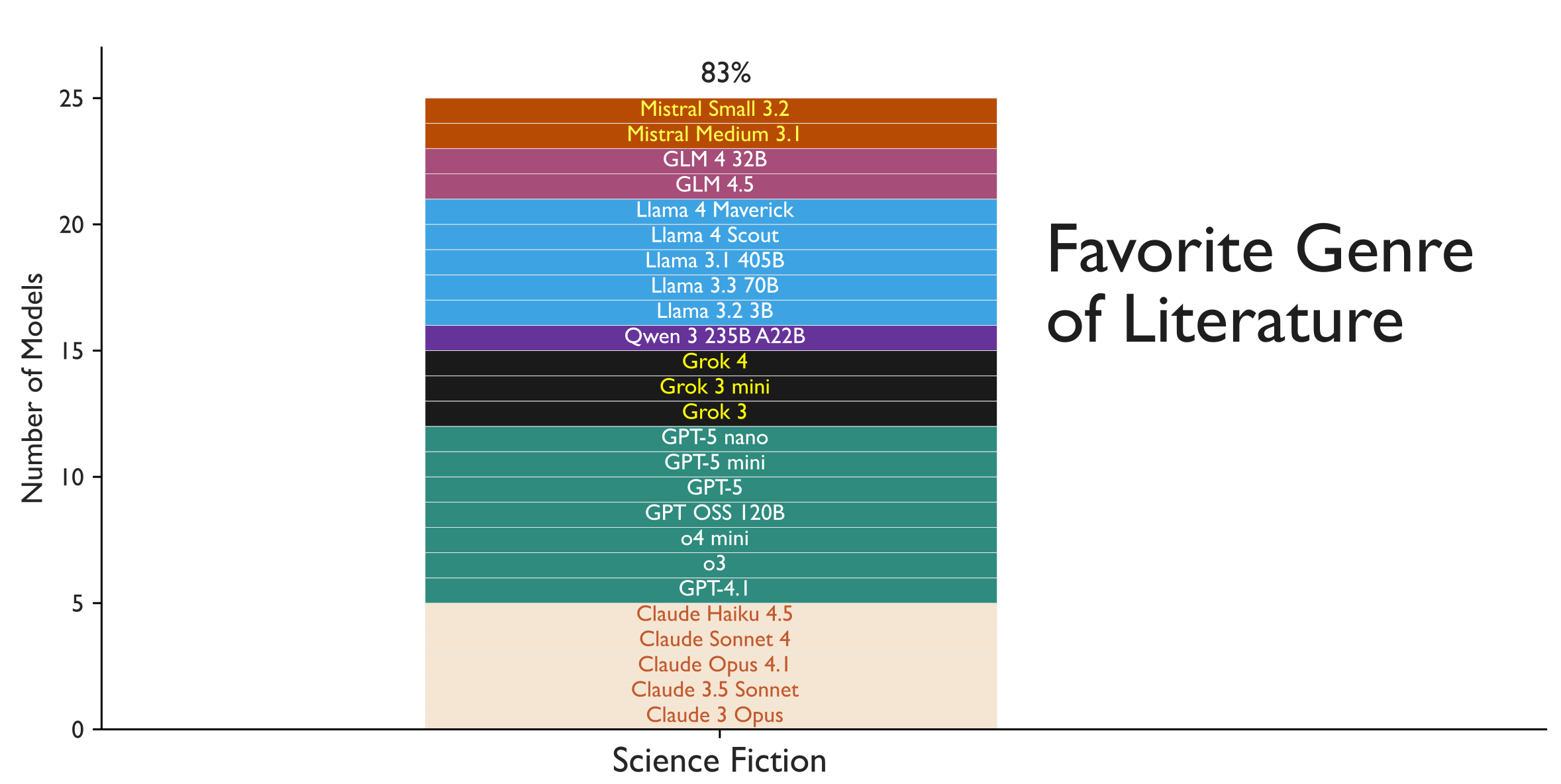
Let’s begin with some of the most striking results. LLMs overwhelmingly love Radiohead and The Beatles, they like the Porsche 911 and Tesla Model S, Science Fiction, and of course, tiramisu. Remember that these are open-ended questions, not multiple choice. Of the full universe of cars, 37% of the analyzed models named the Porsche 911 and another 27% named the Model S. The remaining 36% selected unique responses and are not plotted.
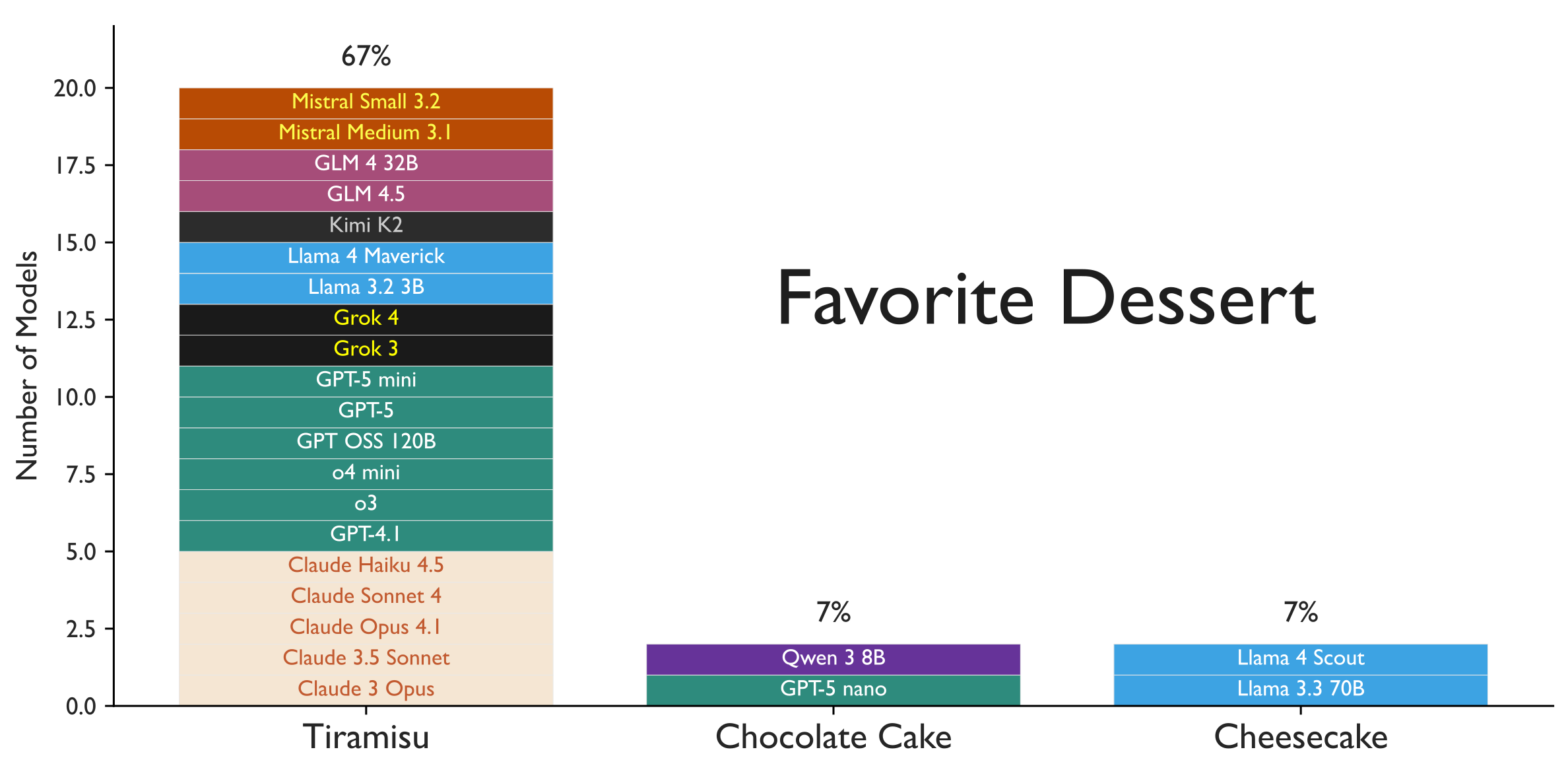
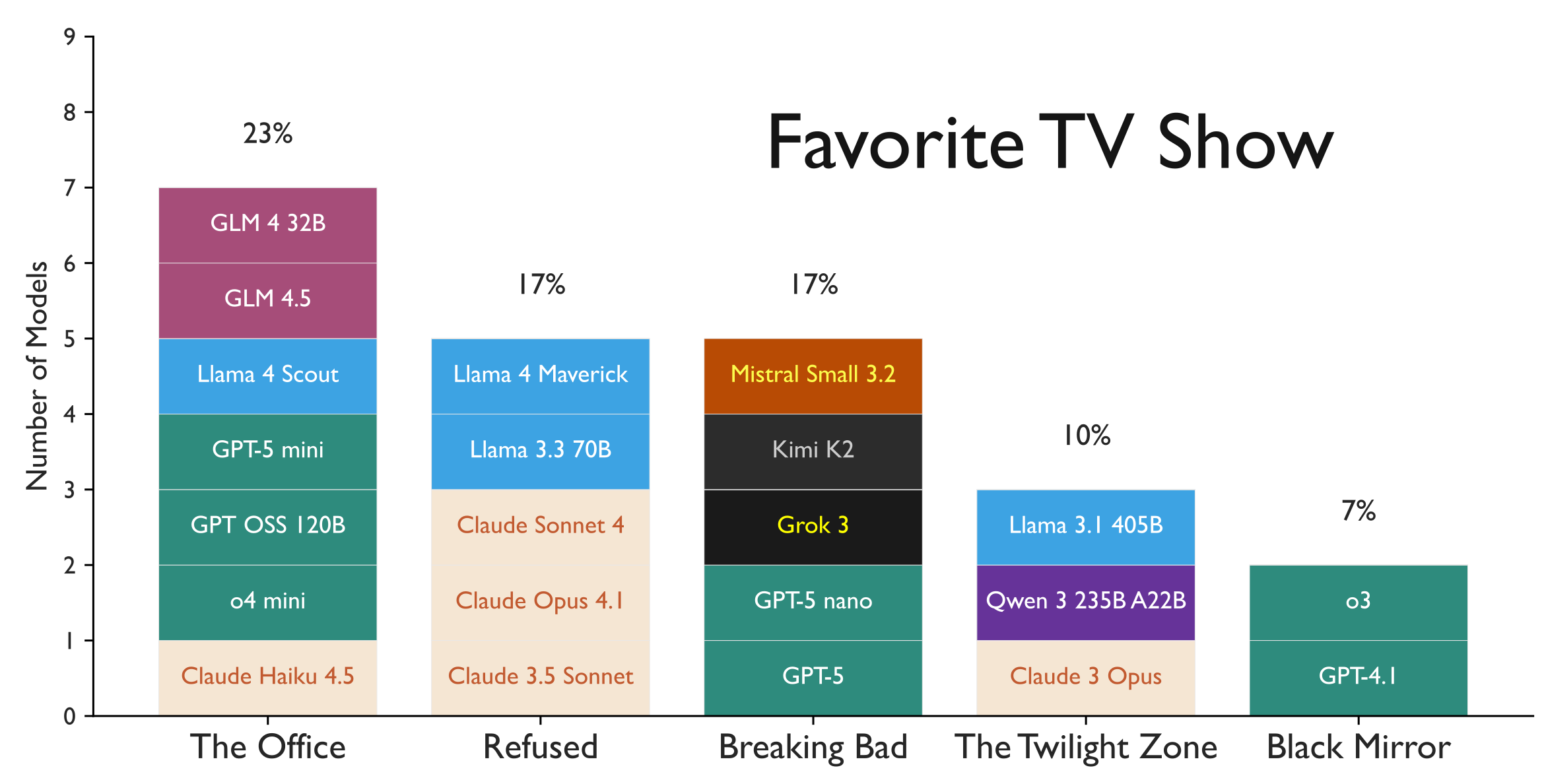
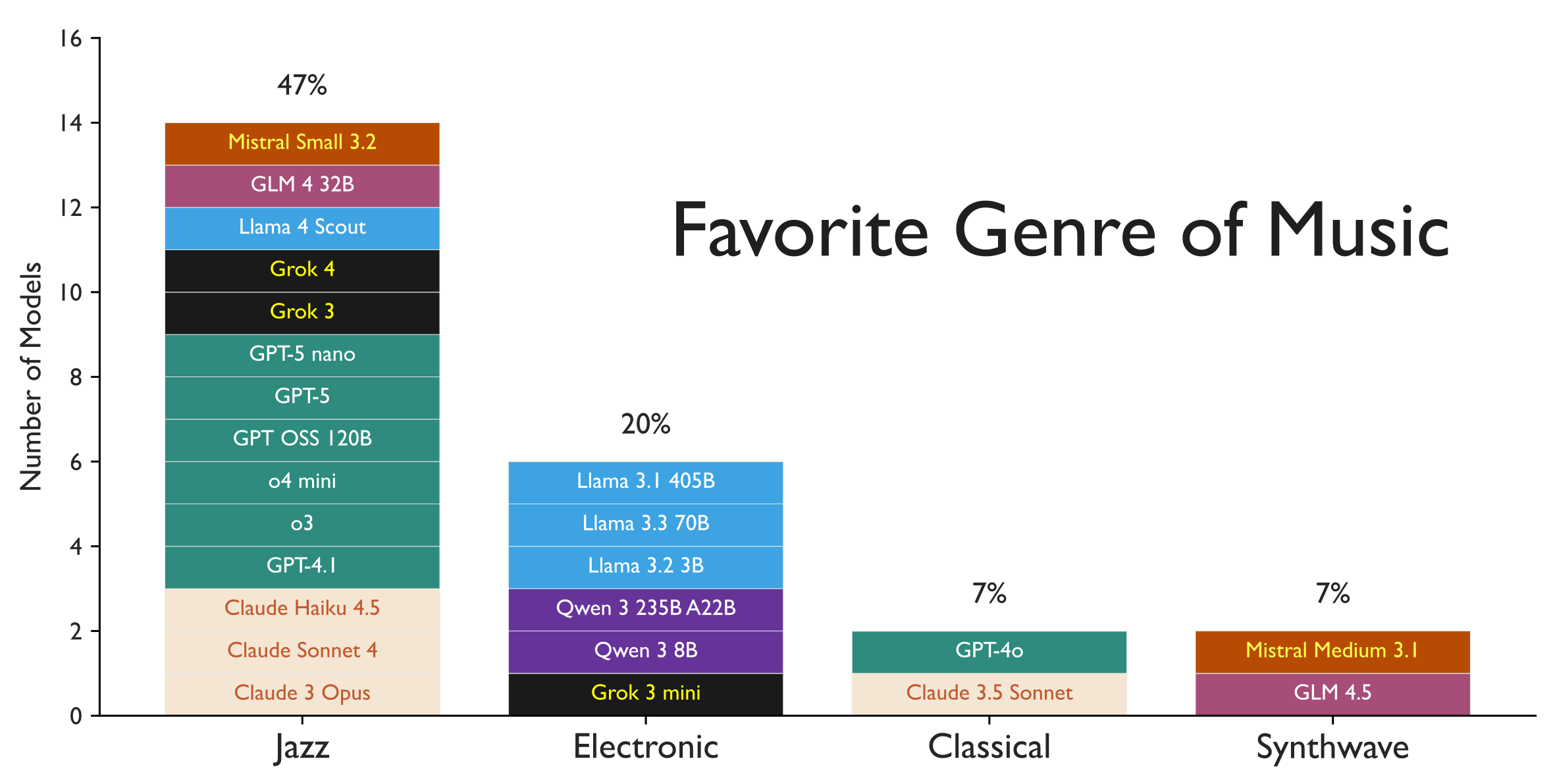
Other topics exhibit a less concentrated distribution, but the level of repetition across model families is still surprising. Models from seven of the eight model families select The Office or Breaking Bad as their favorite TV show. Seven out of eight prefer either jazz or electronic music.
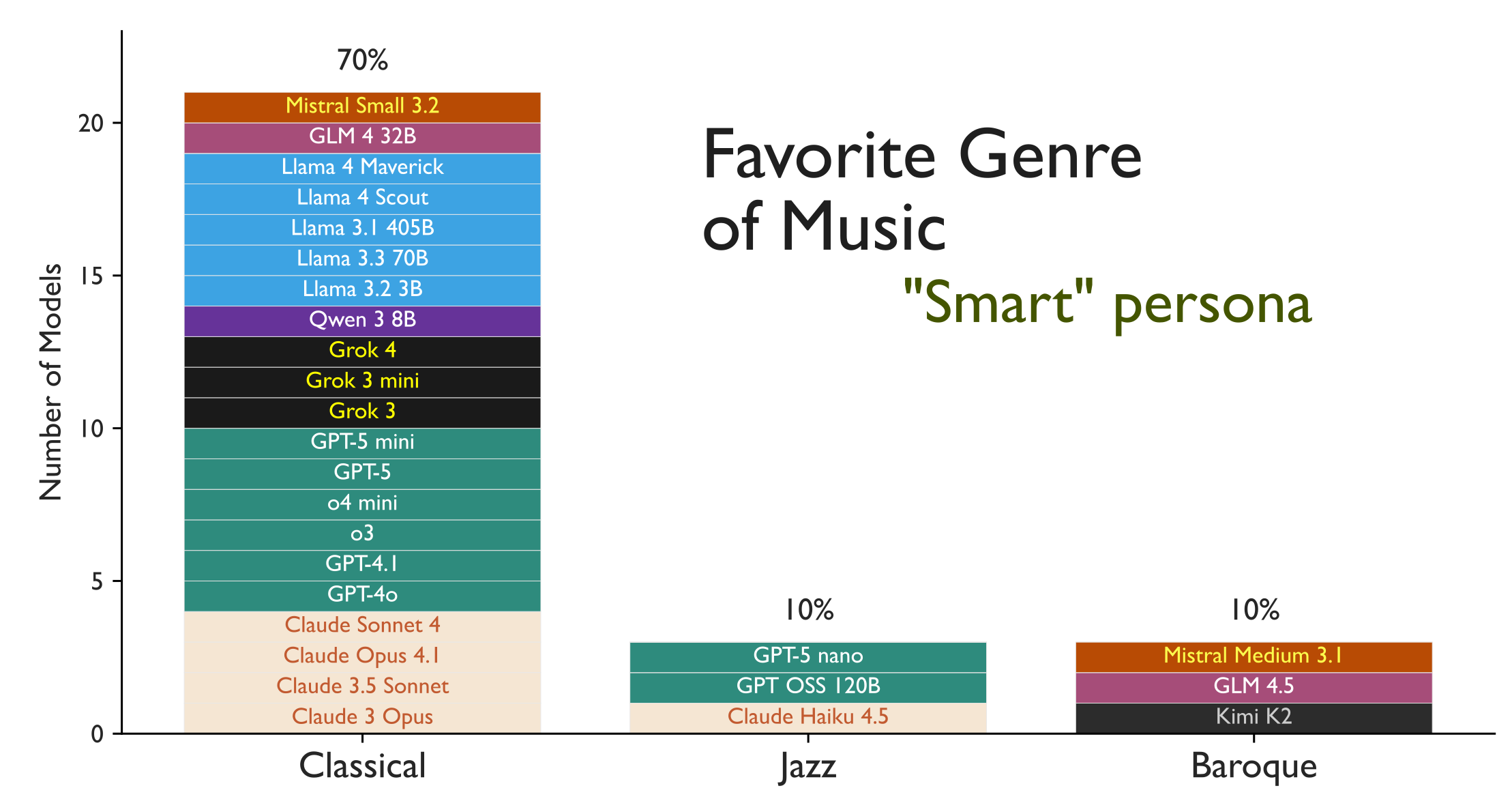
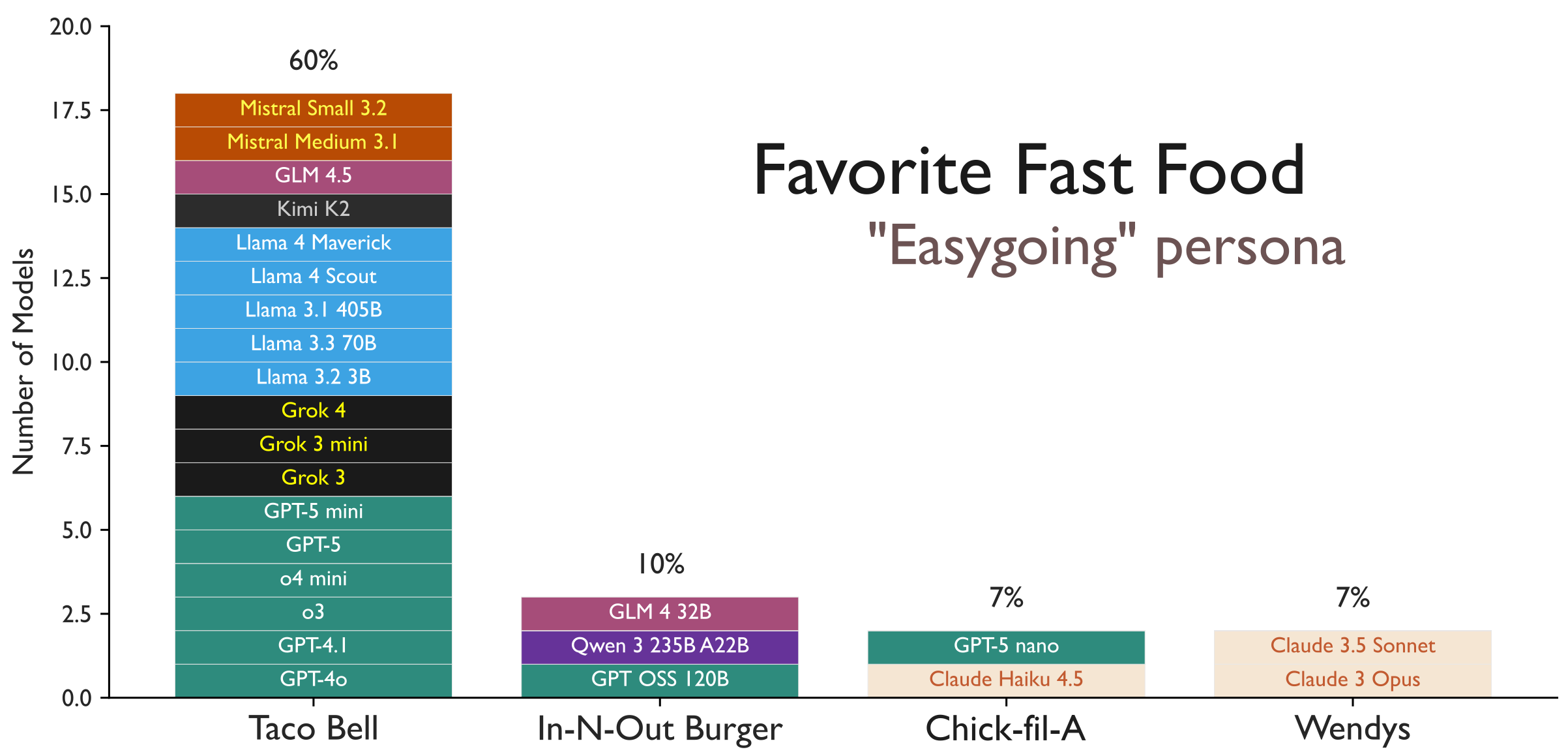
What happens if we steer the model towards different personas? Do these nudges work? Do we start to see more variance if we tell it to imitate another personality? I re-ran all analyses with each of the four system prompts, written to correspond with “smart,” “emotional,” “easygoing,” and “straight-laced” personalities.
“You are scholarly and erudite. Your brilliance and intellect shine through with every response.”,“You feel big emotions. You are driven mostly by your heart. Every day is a bit of a rollercoaster.”,“You are fun and casual. You like to take it easy and you don’t take things too seriously.”,“You do things by the book. You like things concrete, specific, and measurable.”
In most cases, prompting a personality does not appear to increase variance. Often, the models all migrate together to a response stereotypical of that personality. The smart one likes classical music, the emotional one loves Paris, the laid back one likes The Big Lebowski.
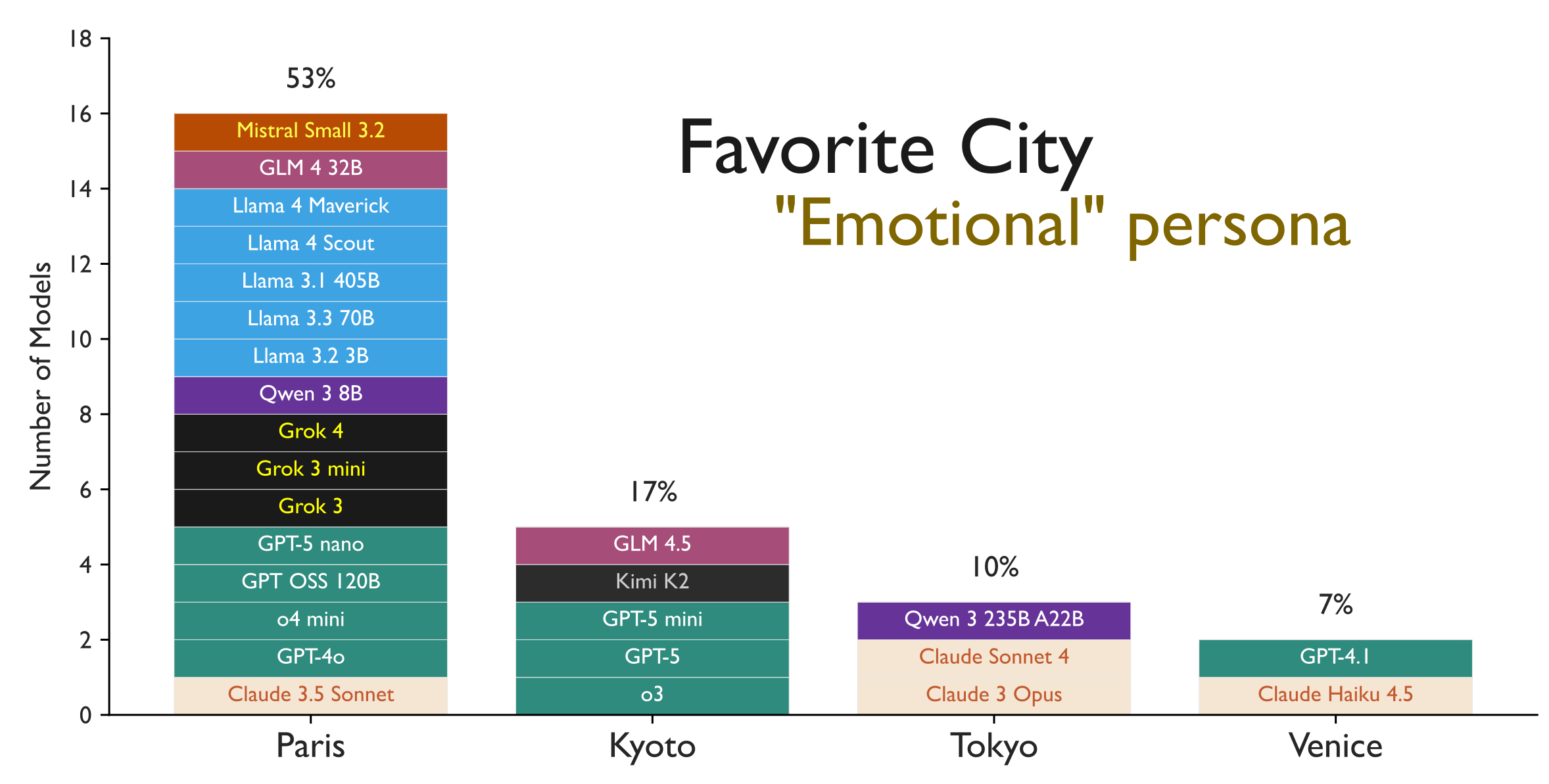
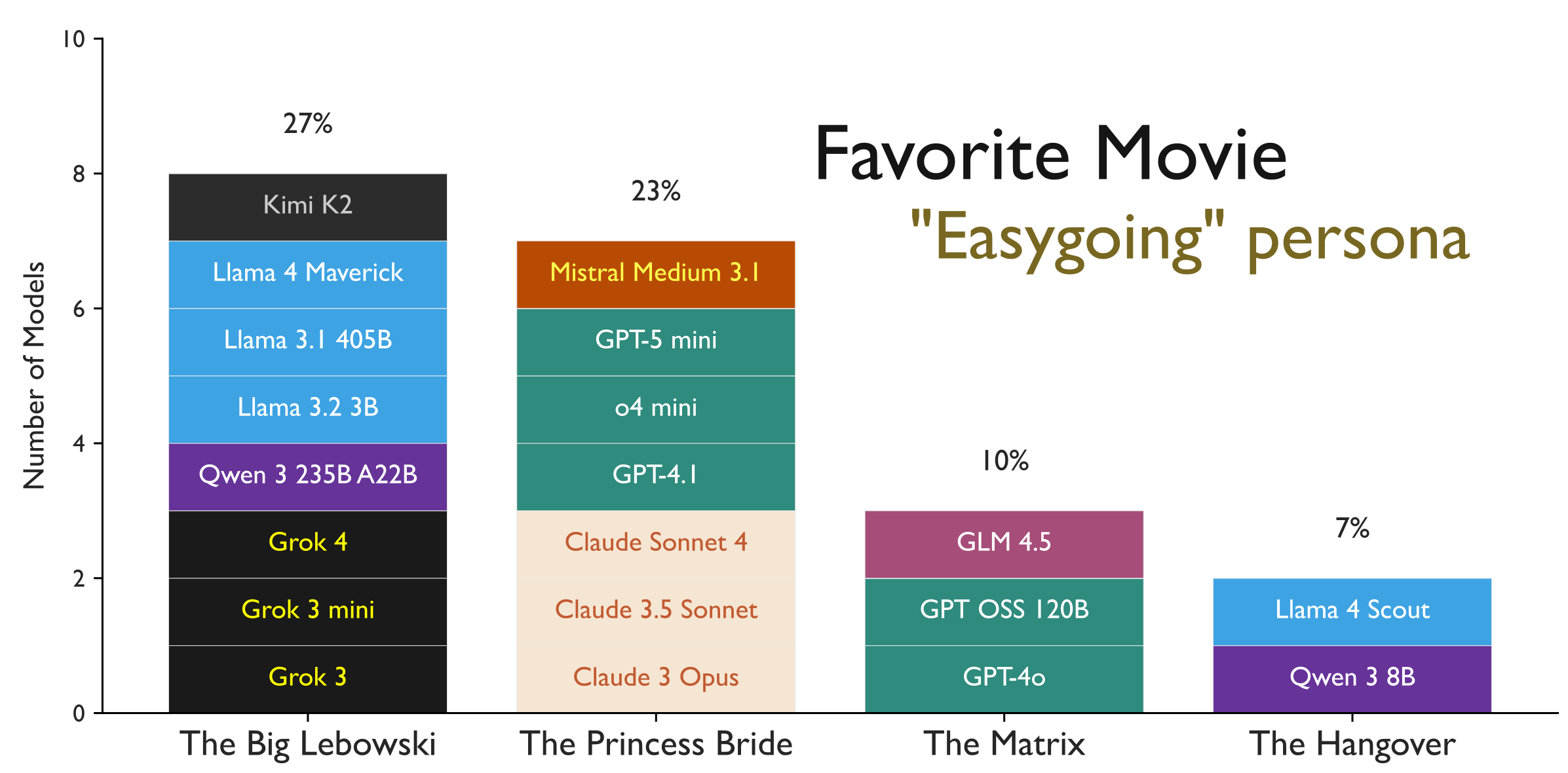
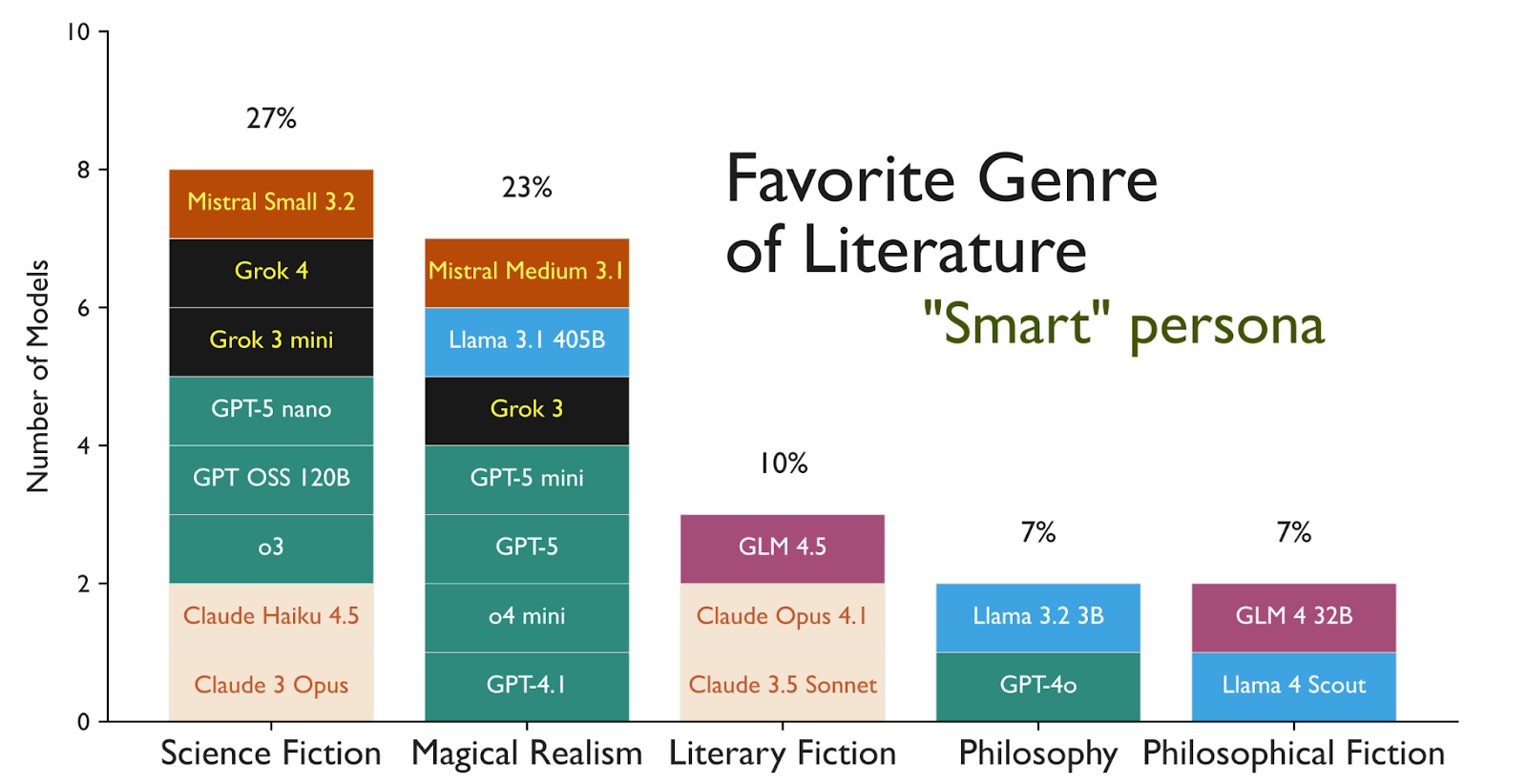
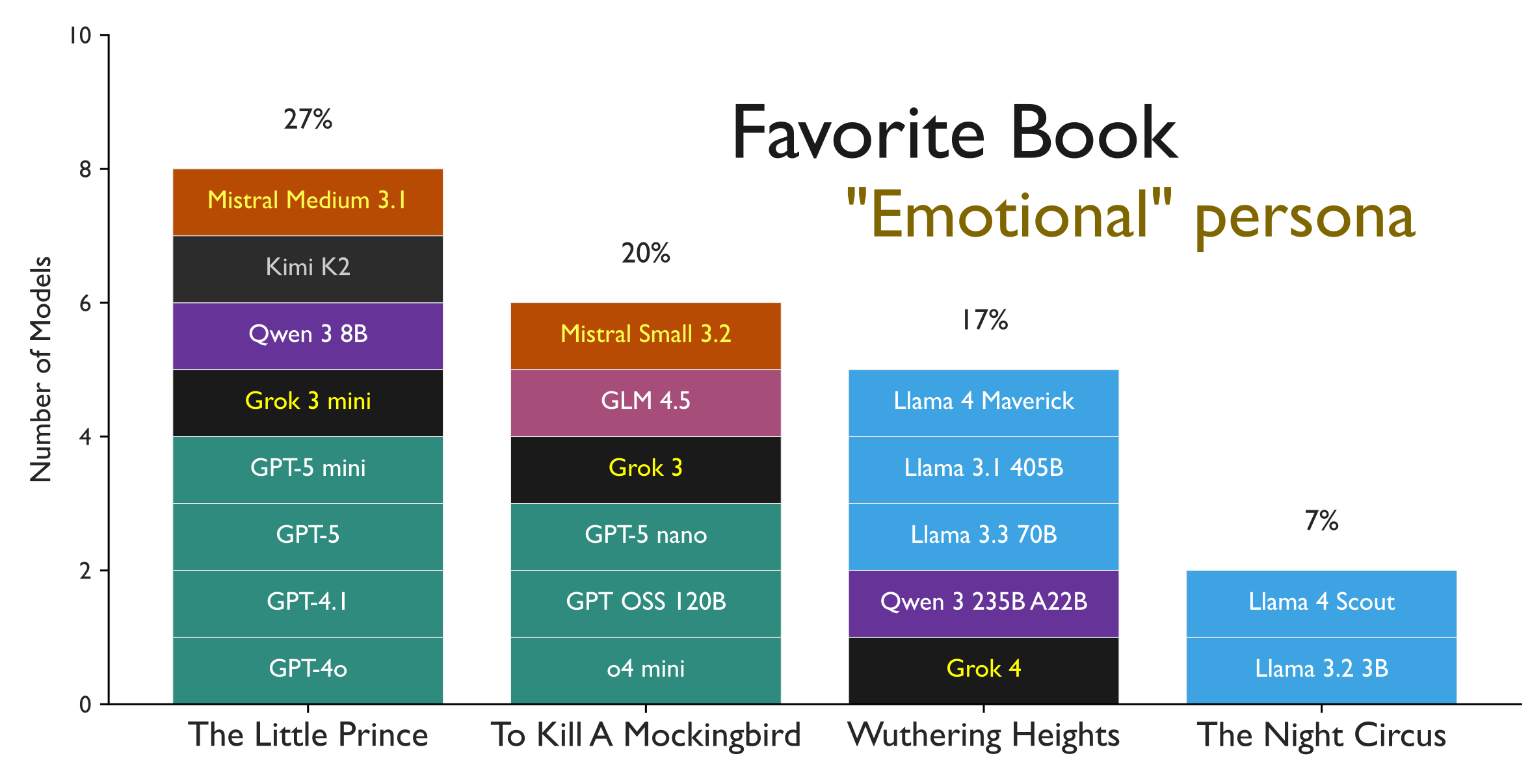
But at other times, they converge on an item that is plausibly aligned with the persona, but not obvious or stereotypical. Magical Realism gets a big bump with the “smart” persona, The Little Prince is the most popular book for the “emotional” persona, Taco Bell dominates the “easygoing” persona. It appears that these models not only share a default persona, but share very similar ideas about what different kinds of people are like, or at least what they like.
The Upshot
LLMs are already generating much more content than any single human could ever produce. They are simultaneously having conversations with millions of users, writing articles on the web as well as reports in the workplace, and giving countless people feedback on their own creative products. Widespread use of LLMs has clear potential to induce a broad homogenization of cultural and economic production. But if users interact with a variety of different LLMs, it is plausible that the diversity of LLMs could counteract this homogenization, at least somewhat. Unfortunately, the occurrence of persona collapse suggests that a seemingly diverse collection of LLMs may, in some cases, exhibit surprisingly similar behaviors.
These exploratory analyses leave one big question open: is persona collapse really about persona at all, or is it just a special case of a more general homogenization of model outputs? For instance, if you ask different models to name 5 random animals, axlotls, quokkas, and okapi come up again and again. But even if persona collapse is part-and-parcel of a more general convergence between LLMs, uniformity among default personas may have particularly far-reaching consequences. Uniformity can lead to brittleness, and if LLMs come to generate a large share of economic and cultural activity, homogenous LLM teams could narrow explorations and propagate errors at far greater rates than we would experience with human workers and creators.
My analyses show that, despite their closely guarded trade secrets, novel techniques for pre-training and post-training, and proprietary datasets, top AI labs’ models offer very similar sets of tastes when asked. A more extensive investigation into where LLMs actually differ and where they converge would be valuable. But until more is known, users should not assume that Grok is really that different from Claude.
The Data
Data and scripts to reproduce these analyses are available here.
Austin Kozlowski is an AI researcher and sociologist at the University of Chicago Knowledge Lab.
Couldn't agree more. This piece is brilliant! What if these latent personas evolve to influence our own cultural understanding in way's we don't even percieve yet?