Heuristic-Based Ideation for Guiding LLMs Toward Structured Creativity
We introduce Ideation Heuristics, a framework towards structured creativity.


Large Language Models (LLMs) are rapidly changing how we think, write, and even discover. In science, their potential to accelerate research ideation and hypothesis generation is very exciting. Yet, current ideation approaches often rely on ad-hoc strategies (e.g., combining insights from two papers), lacking a systematic framework to guide this creative process. In this blog, we introduce Ideation Heuristics, a framework towards structured creativity.
Ideation Heuristics for Systematic Ideation
We formalize the cognitive strategies that support creative idea generation into Ideation Heuristics. By drawing on heuristics of human ideation, Ideation Heuristics can help LLMs explore the space of possible ideas in a more comprehensive way.
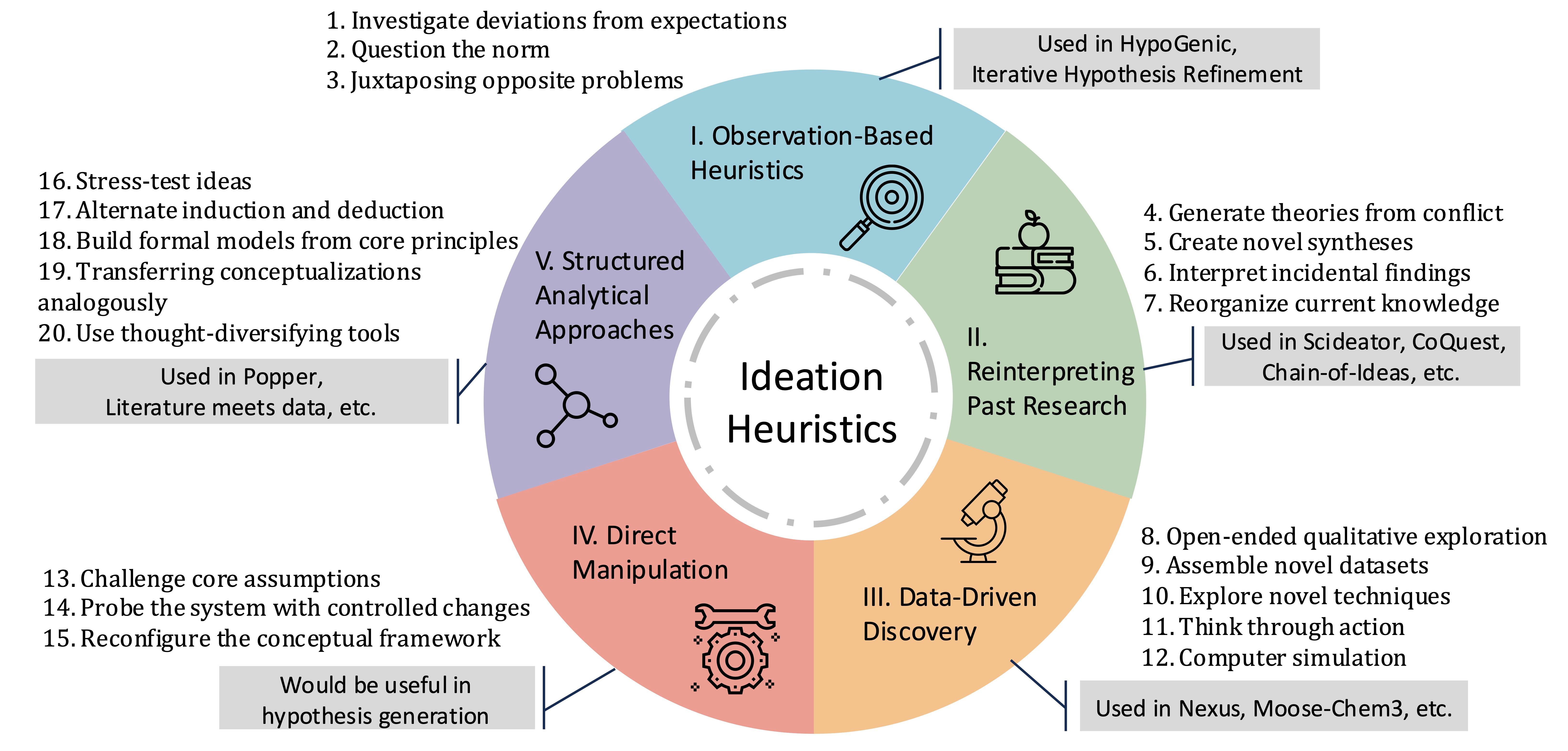
Inspired by McGuire (1997), a seminal work on human ideation heuristics, we propose 20 heuristics organized into five categories that capture the diverse ways researchers generate new ideas. Below, we show the detailed heuristics and examples of how they are used in research ideation and hypothesis generation, including human research and LLM-based ideation methods.
Observation-Based Heuristics
Drawing inspiration from real-world phenomena and anomalies.
These heuristics guide researchers in transforming everyday occurrences and reflections into formal inquiries. One strategy is to investigate deviations from expectations (H1) by noticing outliers, anomalies, or surprising results and asking why they occur. This often leads to uncovering hidden mechanisms or flawed assumptions. Complementing this is the heuristic to question the norm (H2), which encourages examination of why a widely accepted pattern, theory, or convention exists in the first place. Such questioning can reveal unexamined principles, implicit biases, or alternative explanations for established phenomena. Another strategy is to juxtapose opposite problems (H3), where a deep understanding of an issue emerges from studying its inverse, allowing the contrary problems to suggest solutions for each other.
In human research:
Non-Euclidean geometry exemplifies H2 by challenging the long-assumed universal truth of Euclid’s parallel postulate, revealing that questioning even the most obvious norms can open entirely new mathematical worlds.
In LLM-based ideation:
HypoGeniC and Iterative Hypothesis Refinement exemplify the use of H1 in hypothesis generation by iteratively producing and refining hypotheses from cases that the current hypotheses fail to explain. In this way, anomalies are transformed from obstacles into drivers of discovery.
Reinterpreting Past Research
Finding new meaning or opportunities within existing findings.
This category highlights heuristics for mining existing literature productively. One approach is to generate theories from conflict (H4), which involves identifying and reconciling contradictory findings across studies to form a more comprehensive understanding. Researchers can also create novel syntheses (H5) by linking concepts from previously unrelated research, thereby unlocking new insights and theoretical frameworks. Another pathway is to interpret incidental findings (H6), paying close attention to unexpected interactions, side effects, or secondary results that earlier studies did not prioritize. Finally, scholars can reorganize current knowledge (H7) by systematically restructuring the literature of a field to expose promising directions for further investigation.
In human research:
A contaminated Petri dish reveals an unexpected bacterial killing zone around Penicillium mold, an incidental observation that catalyzed the discovery of modern antibiotics, exemplifying H6.
In LLM-based ideation:
A large proportion of existing ideation methods (e.g., SciMON, AI Researcher, ResearchAgent) are primarily driven by literature, and several explicitly instantiate these heuristics. Scideator and MOOSE-Chem adopt H5 by creating novel syntheses across papers: Scideator recombines research facets across papers (e.g., pairing the purpose of one study with the mechanism of another) to generate inventive ideas, while MOOSE-Chem combines background knowledge and inspiration knowledge from different papers.
On the other hand, Chain-of-Ideas and CoQuest share the idea of H7, structuring literature into either sequential chains or graphs to uncover new gaps and opportunities.
Data-Driven Discovery
Identifying patterns or gaps emerging from data itself.
Researchers may begin with open-ended qualitative exploration (H8), using methods such as ethnography or case studies to gather rich narratives that spark new insights. They can also assemble novel datasets (H9) by connecting disparate sources or mining raw data, thereby enabling questions that were previously intractable. In addition, advances in technology make it possible to explore novel techniques (H10) in measurement, computation, and analysis, broadening the range of feasible investigations.
Beyond collecting and creating data, researchers can actively interact with it: one strategy is to think through action (H11), building prototypes, running pilot studies, or testing preliminary interventions to obtain rapid feedback and refine ideas. Finally, computer simulation (H12) allows the exploration of complex systems through modeling, testing “what-if” scenarios, and generating hypotheses that would be difficult to evaluate directly in the real world.
In human research:
By analyzing qualitative interviews without preset hypotheses, researchers inductively derive new theories of social processes through the methodology of grounded theory, an exemplar of H8.
In LLM-based ideation:
Nexus illustrates H9 by linking previously disconnected data sources to create new opportunities for hypothesis generation. Liu et al. (2025) demonstrate H11 through integrating preliminary validation on empirical datasets into the ideation process. MOOSE-Chem3 applies H12 by simulating experimental feedback to refine and rank hypotheses, treating simulation as a proxy for costly laboratory experimentation.
Direct Manipulation
Actively tweaking variables, models, or assumptions.
When you already have a proposition, here are heuristics designed to break conventional thinking patterns. One technique is to challenge core assumptions (H13) by systematically questioning foundational beliefs, considering circumstances in which the opposite might hold, or reversing presumed causal directions. Researchers may also probe the system with controlled changes (H14), testing behavior under both small perturbations and large boundary-pushing shifts to expose the system’s structure and limits. Lastly, they can reconfigure the conceptual framework (H15) by altering an idea’s core components, such as variables and relationships, to reveal overlooked dynamics. For example, introducing moderators can reshape causal interpretations, while removing well-established effects may uncover hidden patterns.
In human research:
While these heuristics are not yet fully implemented in LLM-based ideation systems, they are deeply rooted in scientific discovery. For example, H13 echoes Albert Einstein’s rethinking of Newtonian absolutes in developing special relativity. Looking forward, such heuristics hold great promise for enriching hypothesis generation by encouraging deeper exploration and conceptual restructuring.
Structured Analytical Approaches
Applying structured thinking to deepen and refine emerging ideas.
A critical step is to stress-test ideas (H16), which involves actively trying to find flaws, counterarguments, or alternative explanations to strengthen the robustness of the core argument. The process can be enhanced by alternating induction and deduction (H17), using iterative cycles of observing specific instances to induce general principles and then using those principles to deduce new, testable hypotheses. For more rigorous theorizing, scholars can build formal models from core principles (H18), translating concepts into mathematical or logical languages to uncover their implications.
Inspiration can also come from transferring conceptualizations analogously (H19), where successful concepts or methods from one field are adapted to provide new perspectives in another field. Finally, the use of thought-diversifying tools (H20), such as checklists and conceptual diagrams, encourages systematic exploration of a problem’s dimensions and generates a broader range of innovative solutions.
In human research:
Early convolutional networks draw analogy from Hubel and Wiesel’s findings about hierarchical feature processing in the mammalian visual system, exemplifying H19.
In LLM-based ideation:
Popper operationalizes H16 through iterative falsification. Literature Meets Data demonstrates H17 by alternating between inductive literature-based and deductive data-driven reasoning. Yang et al. (2025) exemplify H18 by formalizing hypotheses via Inductive Logic Programming, while H20 is embodied by meta-frameworks like this blog, systematically organizing heuristics to broaden the landscape of innovation.
Each category represents a different source or stage of inspiration within the research process. The first three often ignite new ideas—starting from what we see, know, or measure—while the latter two help us challenge and refine those ideas into more rigorous hypotheses.
Of course, research is rarely linear. Data-driven anomalies might loop back into new observations; reinterpreting an old theory might point us toward a fresh dataset; and structured analysis might reveal hidden assumptions that invite direct manipulation. Rather than separated paths, these heuristics offer a comprehensive toolkit for navigating the ideation process.
Researchers Find the Heuristics Useful
To assess the real-world usefulness of our proposed Ideation Heuristics, we survey 13 researchers, including 8 postdocs and 5 professors. These participants represent a wide array of academic fields, including computer science, mathematics, natural science (chemistry, biology, material science), and social studies (law, sociology, and business).
Each participant rates the usefulness of all 20 heuristics within their discipline on a three-point scale: very useful, moderately useful, or not useful.
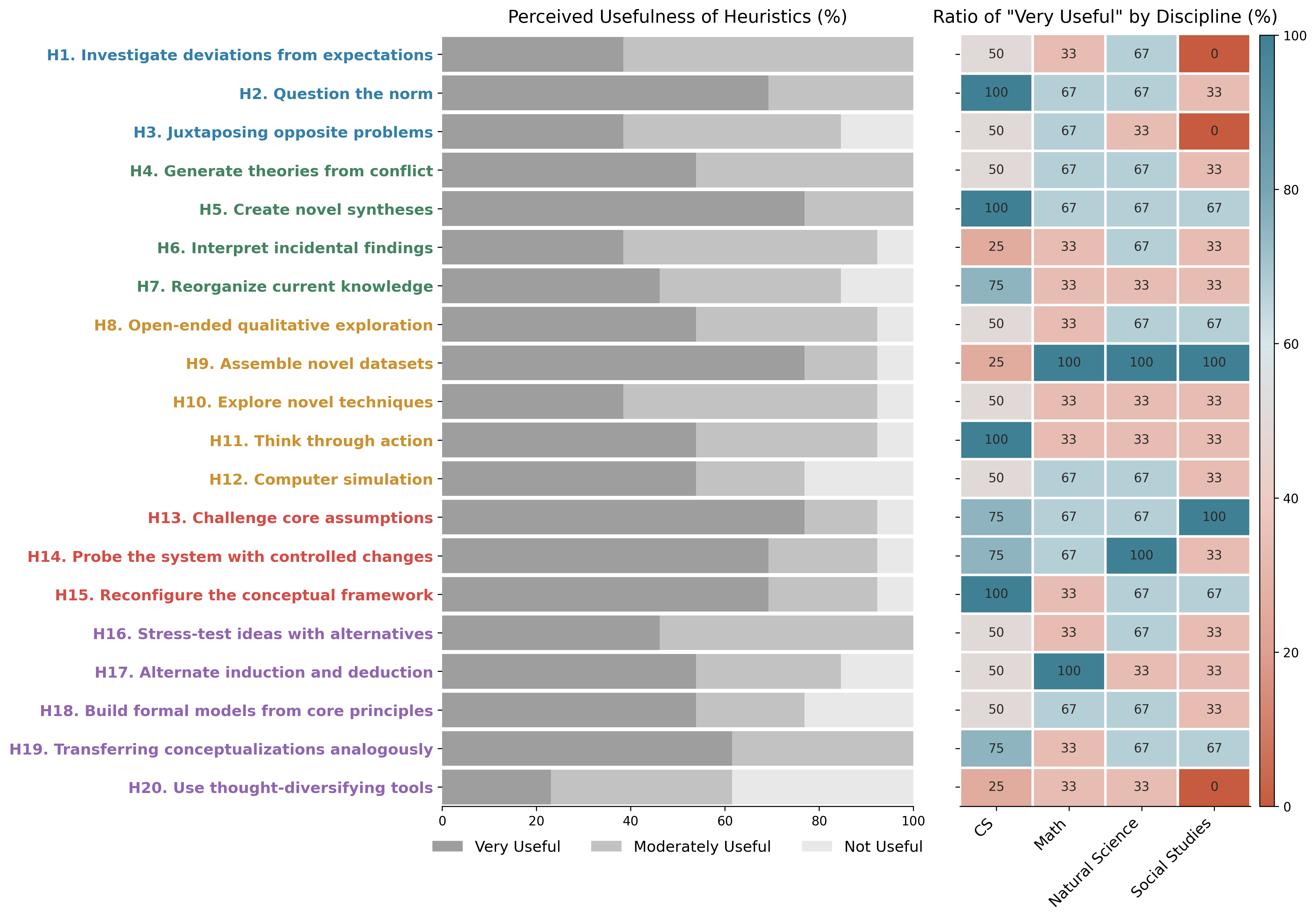
The heuristics successfully capture practical and widely recognized strategies for research ideation across disciplines. Across all responses, 55% of ratings are very useful, and an additional 36% are moderately useful. Notably, 13 out of the 20 heuristics are rated very useful by a majority of participants, and every heuristic is considered at least useful (i.e., very or moderately useful) by over 60% of respondents.
While broad consensus emerges, we also observe meaningful disciplinary differences, reflecting the distinct epistemic styles and methodologies of each field:
Computer Scientists unanimously rate think through action (H11) and reconfigure the conceptual framework (H15) as very useful, underscoring their preference for iterative building, prototyping, and system manipulation.
Mathematicians, by contrast, are the only group to unanimously endorse alternate induction and deduction (H17) as very useful, aligning with the field’s logical and proof-oriented nature.
Natural Scientists emphasize empirical experimentation, giving highest ratings to probe the system with controlled changes (H14), a heuristic that encapsulates the experimental method itself.
Social Scientists prioritize heuristics tied to critical theory and qualitative reasoning, strongly favoring open-ended qualitative exploration (H8) and challenge core assumptions (H13).
How to Use the Heuristics
You can try Ideation Assistant on Hypogenic.ai, which integrates this framework with paper search for guided ideation. And if you come up with an interesting idea but don’t have the bandwidth to pursue it, we’d love for you to share it on IdeaHub!
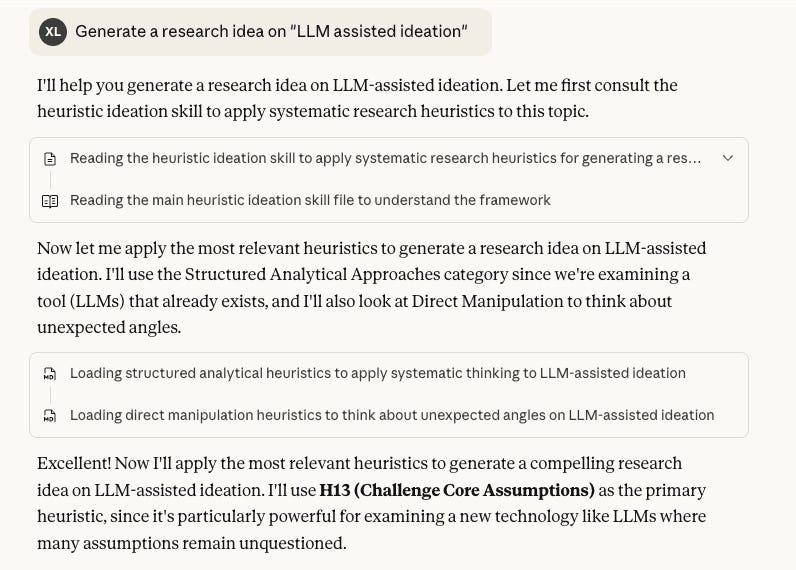
To make the ideation heuristics directly actionable, we also develop a Claude skill called heuristic-ideation, inspired by the Claude Scientific Skills project. The skill is available at https://github.com/heuristic-ideation/heuristic-ideation-skill.
You can use the skill by simply uploading it to Claude. Once enabled, Claude automatically applies the heuristic-based framework during ideation, helping you propose research ideas and hypotheses in a more systematic way. The skill first identifies relevant heuristic categories, then selects specific heuristics by referencing their detailed descriptions, and finally applies them to guide the ideation process.
Future Directions
Looking ahead, the Ideation Heuristics framework opens up several promising directions for ideation research.
One direction is to design new ideation methods that explicitly operationalize these heuristics, moving beyond simple prompting toward tool-augmented agentic frameworks.
Another opportunity lies in exploring how LLMs can internalize and apply the heuristics more intelligently. LLMs can learn not only how to use each heuristic, but also when to use which heuristic, depending on the problem context, stage of inquiry, and available information. This includes developing meta-reasoning capabilities that allow models to dynamically select, sequence, or combine heuristics, as well as mechanisms for models to reflect on and justify their heuristic choices.
Ultimately, a deeper understanding of how to integrate human-inspired heuristics into LLM reasoning may yield more systematic, reliable, and creative LLMs for scientific discovery.
We sincerely thank all the researchers who took the time to complete our survey. If you find our blog useful, please cite:
@misc{heuristic_based_ideation,
  title={Heuristic-Based Ideation for Guiding LLMs Toward Structured Creativity},
  author={Xiao Liu, Haokun Liu, Chenhao Tan},
  year={2026},
  url={https://cichicago.substack.com/p/heuristic-based-ideation-for-guiding}
} | A guest post by
|